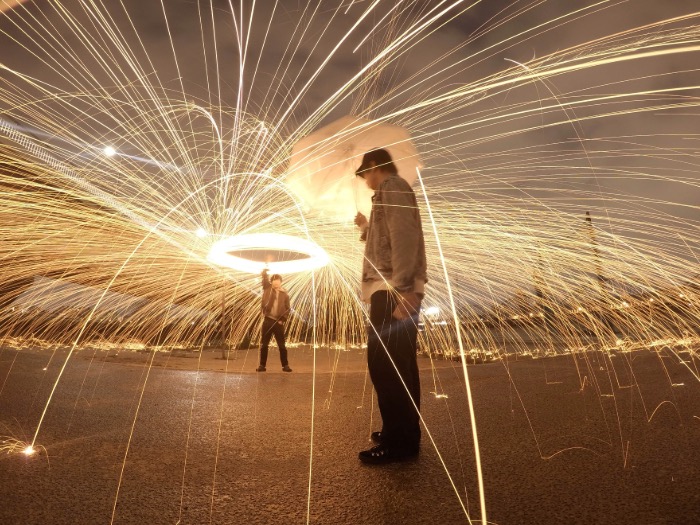
It was Einstein who coined a faintly derogatory term for quantum entanglement – ghostly or spooky action at a distance. This was mainly because it seemed to challenge his theory that nothing can travel faster than light. But that proved not to be the case. Quantum entanglement, now a proven fact, shows that when two or more particles become linked – the state of one directly correlates with the state of the other, regardless of distance. Non-locality – its companion principle – reveals the observable effects of entanglement when two or more particles are separated, even by vast distances. When one particle is measured, its state becomes definite at that precise moment and the other particle(s) linked to it, are mysteriously simultaneously known, though no signal travels between them. This seems to parallel Carl Jung’s ideas around synchronicity which posits that two or more events happening simultaneously, may reflect each other in a meaningful way, without a causal link. He named this an acausal connecting principle. This principle has been applied astrologically to show that, for instance, the fact that Mars rising in a natal chart may indicate athletic ability, is not be because Mars caused that ability, but because they reflect each other.
The same principle seems to work through intense concentration on a specific subject, where books mysteriously open at the right page or events happen which contribute to the completion of a particular project.
Both entanglement and non-locality appear to apply to human relationships, and even to objects. In the former case, when we have a relationship with someone, it doesn’t matter where they are in the world, whatever happens to them somehow reaches us and has an effect. The strength of that effect seems to be proportionate to the closeness and significance of that relationship.
In a more secular way, in terms of our relationship to objects, it could be said that we become ‘entangled’ even when we accidentally knock over something like a chair. At that moment, we have formed a kind of relationship with it which makes it stand out from all the other objects around us. Non-locality/entanglement applies because even when we are separated from the chair, we continue to have a relationship with it, albeit one we would have no reason to think about, unless we were to return to it.
In his book Entangled Minds – Extrasensory Experiences in a Quantum Reality (2006) Dean Radin, Chief Scientist at the Institute of Noetic Science, suggests that consciousness may be interconnected in a way similar to quantum entanglement. In the light of these ideas, this seems likely. -
2025 has been designated UNESCO year of Quantum Science and Technology. The Fintry Trust Summer School takes place on Thursday 17th to Sunday 20th July and will explore the theme As Above, So Below: The Wisdom of Integral Science. Guest Speakers will be internationally acclaimed theologian and priest Matthew Fox. Matthew will speak on his book, co-authored with biologist Rupert Sheldrake, The Physics of Angels: Exploring the Realm Where Science and Spirit Meet. We also welcome Wakyani Hoffman, an expert in Ubuntu wisdom and ethical AI. Find out more